How SEO Services Help Improve Conversion Rates

Traffic looks impressive in a report. Revenue pays the bills.
That tension sits at the center of most SEO conversations. A business hires an agency or builds an in-house search strategy because it wants more visibility, more qualified visitors, and ultimately more sales, leads, demos, bookings, or inquiries. Yet many companies still treat SEO as a top-of-funnel activity only, useful for attracting attention but somehow disconnected from conversion performance.
That view misses how search behavior actually works. People use search engines at every stage of decision-making. Some are comparing options, some are looking for proof, some are checking pricing, and some are moments away from buying. Well-executed SEO Services do not just bring in more visitors. They improve the match between what a person needs and what a website delivers. That alignment has a direct effect on conversion rates.
When SEO is handled with commercial intent in mind, it sharpens page relevance, improves user experience, reduces friction, and helps the right visitors land on the right pages at the right moment. Those changes often lift conversion rates even before traffic grows substantially.
The real connection between SEO and conversion
A conversion happens when intent meets confidence.
Someone searches for a solution, finds a result that seems promising, lands on a page that answers the question clearly, trusts what they see, and takes the next step. If any part of that chain breaks, conversion drops. SEO influences every link in that chain.
A lot of business owners learn this the hard way. They invest in content around broad keywords, win rankings, and then wonder why inquiry volume stays flat. The issue is rarely search traffic itself. More often, the site is attracting visitors who are curious rather than ready, or the landing page does not carry the same promise as the search result.
I have seen this with service firms, software companies, clinics, manufacturers, and local businesses. One company can rank for SEO Services Magister Digital AI a high-volume keyword and celebrate the graph moving up, while another ranks for a lower-volume phrase with stronger buyer intent and quietly doubles lead quality. Traffic without fit creates noise. Search with intent alignment creates action.
That is why conversion-focused SEO starts with a basic question: what is the searcher trying to accomplish right now?
Search intent is where conversion gains begin
The strongest SEO campaigns are built around intent segmentation, not just keyword volume.
A person searching “what is payroll software” has different needs from someone searching “best payroll software for 50 employees” or “payroll software pricing.” Those queries may belong to the same category, but they signal different readiness levels. If all three searchers land on the same generic page, conversion suffers.
Good SEO Services map keywords to business goals and create content or landing pages that fit the stage of the decision process. Informational content can educate and warm prospects. Comparison pages can help evaluators narrow choices. Service pages, product pages, location pages, and solution pages can capture high-intent visitors who are ready to contact, book, or buy.
This is one of the least glamorous parts of SEO, but it is often where conversion rate improvements begin. Keyword research done properly is not just a spreadsheet exercise. It is market research in disguise. It reveals how customers describe their problem, what objections they have, which alternatives they consider, and what details matter before they commit.
A page built around the wrong intent can rank and still underperform. A page built around the right intent may bring less traffic, but produce far more revenue per visitor.
Better landing pages turn rankings into results
A common misconception is that SEO stops at getting someone onto the site. In practice, the landing page experience matters just as much as the ranking itself.
If a page ranks for “emergency plumber near me” but opens with a vague brand statement, buries the phone number, loads slowly, and forces the user to scroll for basic information, the visit is wasted. The ranking did its job. The page did not.
Conversion-minded SEO Services usually involve landing page refinement because search engines and users reward many of the same qualities. Clear page structure, obvious relevance, concise explanations, fast load times, readable formatting, and a visible next step all help.
There is also a subtler effect at work. Searchers arrive with expectations shaped by the query and the snippet they clicked. When the page confirms those expectations quickly, trust rises. When it feels off-topic, padded, or generic, trust drops. People do not always analyze this consciously. They just leave.
I worked with a B2B firm that ranked well for a group of service-specific keywords but had weak inquiry rates. The pages were technically fine, but they read like brochure copy. We restructured them around the actual questions buyers asked during sales calls, added proof points, clarified industries served, and made the call to action more specific. Traffic barely changed in the first two months. Conversion rate improved by roughly 30 percent. The missing piece was not visibility. It was message fit.
Technical SEO affects conversion more than most teams expect
Technical SEO often gets framed as a back-end discipline for crawling and indexing. That is true, but incomplete.
Site speed, mobile usability, internal linking, indexation hygiene, and page architecture all influence whether visitors can complete a task without frustration. A page that takes five or six seconds to become usable on mobile leaks conversions. A site that creates duplicate or thin pages confuses both search engines and users. A messy internal linking structure can strand high-intent visitors far from the page they actually need.
The relationship between speed and conversion has been observed across industries for years. Exact lift varies by business model, audience, and device mix, but the pattern is consistent. Friction costs money. People may tolerate some delay if the need is urgent, but most do not. On phones, patience is even thinner.
Technical improvements also shape perceived credibility. Visitors rarely say, “I did not convert because your canonical tags were wrong.” They do say, through their behavior, that the site felt broken, cluttered, or unreliable. Slow-loading forms, layout shifts, intrusive popups, and poor mobile rendering quietly erode trust.
This is one reason strong SEO Services often overlap with CRO work, even if the contract does not use that label. A search team focused on business outcomes will flag technical barriers that reduce both rankings and conversions.
Content quality builds trust before the sales team ever speaks
Conversion is not just about attracting buyers. It is about reducing uncertainty.
People convert when they believe a business understands their problem, can solve it, and is credible enough to trust. Search-optimized content can do that heavy lifting long before a sales conversation begins.
This matters especially in higher-consideration purchases. If someone is hiring a law firm, choosing a medical provider, evaluating a cybersecurity vendor, or comparing commercial contractors, they need more than a flashy homepage. They want evidence. They want specificity. They want to know whether the business has handled situations like theirs before.
SEO-driven content can support this by answering nuanced questions, explaining processes, clarifying outcomes, and addressing objections in plain language. It can also signal expertise through topical depth. A site with thoughtful supporting content usually converts better than one with only a handful of generic pages because it reduces the gap between initial interest and informed confidence.
There is a practical balance to maintain here. Some teams produce content at scale and hope volume will compensate for weak quality. It rarely does. Thin articles may attract low-value traffic and dilute site focus. Stronger results come from fewer pages that answer real questions well and point users toward a relevant next step.
A useful rule is simple: every important page should do two jobs at once. It should satisfy the searcher enough to earn visibility, and it should persuade the visitor enough to earn action.
Local SEO can improve conversion rates dramatically
Local businesses often feel the conversion impact of SEO faster than national brands because intent is so immediate.
When someone searches for a dentist, roofer, divorce lawyer, med spa, or auto repair shop in a specific area, they are often close to acting. They are not browsing casually. They are trying to solve a problem nearby. In these cases, SEO Services that improve local pack visibility, optimize service area pages, strengthen location signals, and enhance business profiles can raise conversion rates quickly.
Why? Because local SEO tends to filter for urgency and proximity. The traffic may be smaller in raw volume, but it is often better qualified. A person searching “HVAC repair in Austin” is a different prospect from someone searching “how does HVAC repair work.” Both matter, but one is much closer to becoming a customer.
Local conversion gains also come from details that sound mundane until they are missing: consistent business information, click-to-call functionality, visible reviews, clear service areas, directions, insurance information where relevant, and realistic descriptions of what happens next. Good local SEO pays attention to those details because they influence both rankings and response rates.
I have seen local pages jump from mediocre performance to strong lead generation with no dramatic redesign, just tighter location targeting, better page relevance, cleaner mobile UX, and stronger trust signals. The page became easier to find and easier to act on.
SEO helps qualify traffic, which makes conversion metrics healthier
One of the most underrated benefits of SEO is that it can improve conversion rates by disqualifying the wrong audience.
That may sound counterintuitive at first. Many businesses are conditioned to want more traffic at any cost. But unqualified traffic drags down engagement, muddies reporting, and sends mixed signals to the sales team. If a page attracts visitors who cannot afford the service, live outside the service area, need a different solution, or are only seeking basic definitions, conversion rate naturally falls.
Smart SEO Services refine targeting so the site becomes more legible. Clear service descriptions, transparent pricing context where appropriate, industry-specific pages, and honest explanations of who the offer is for all help visitors self-select. Some will leave. That is often a win.
A cleaner audience usually leads to better downstream metrics. Lead-to-close rate improves. Sales conversations become more productive. Form submissions contain stronger fit. Revenue per organic visitor climbs, even if traffic growth slows.
This is where SEO becomes a business efficiency lever, not just a marketing channel.
The search snippet influences conversion before the click
Meta titles and descriptions are often treated as minor on-page elements. They are not minor when conversion quality matters.
The snippet is a pre-qualification tool. It sets the expectation for what the searcher will find. If the title is vague, overstuffed, or disconnected from the actual offer, it may attract the wrong clicks. If it is precise and commercially aligned, it can improve both click-through rate and visitor quality.
For example, a page targeting enterprise buyers should not sound like a beginner guide. A premium service should not present itself like a bargain directory listing unless low-price positioning is truly the strategy. Even simple wording changes can influence who clicks and why.
This is a place where experience matters. The goal is not just more clicks. It is better clicks. There are cases where a slightly lower click-through rate produces more conversions because the page is filtering out poor-fit traffic at the search results stage.
That kind of judgment is one reason businesses seek experienced SEO Services rather than only technical execution.
User experience and SEO are no longer separate conversations
For years, some teams treated SEO and user experience as competing priorities. SEO wanted more text, more links, more keyword signals. UX wanted cleaner pages with fewer distractions. The best work now recognizes that the real objective is task completion.
Search engines increasingly reward pages that satisfy users. Users convert on pages that are easy to navigate, clear in purpose, and trustworthy in presentation. The overlap is substantial.
A page that buries its key information beneath filler will frustrate both audiences. A page that organizes content around actual decision needs tends to perform better in rankings and conversions. Strong headings, logical progression, scannable formatting, and concise but sufficient depth help users move from question to confidence without friction.
This does not mean every page must be minimalist. Some industries require detail. Others benefit from shorter copy. The point is fit. The amount of information should match the complexity of the decision. SEO professionals who understand conversion do not chase arbitrary word counts. They shape pages around intent, evidence, and action.
Analytics reveal where SEO is helping and where it is leaking value
One of the clearest signs that SEO is being managed well is the quality of measurement around it.
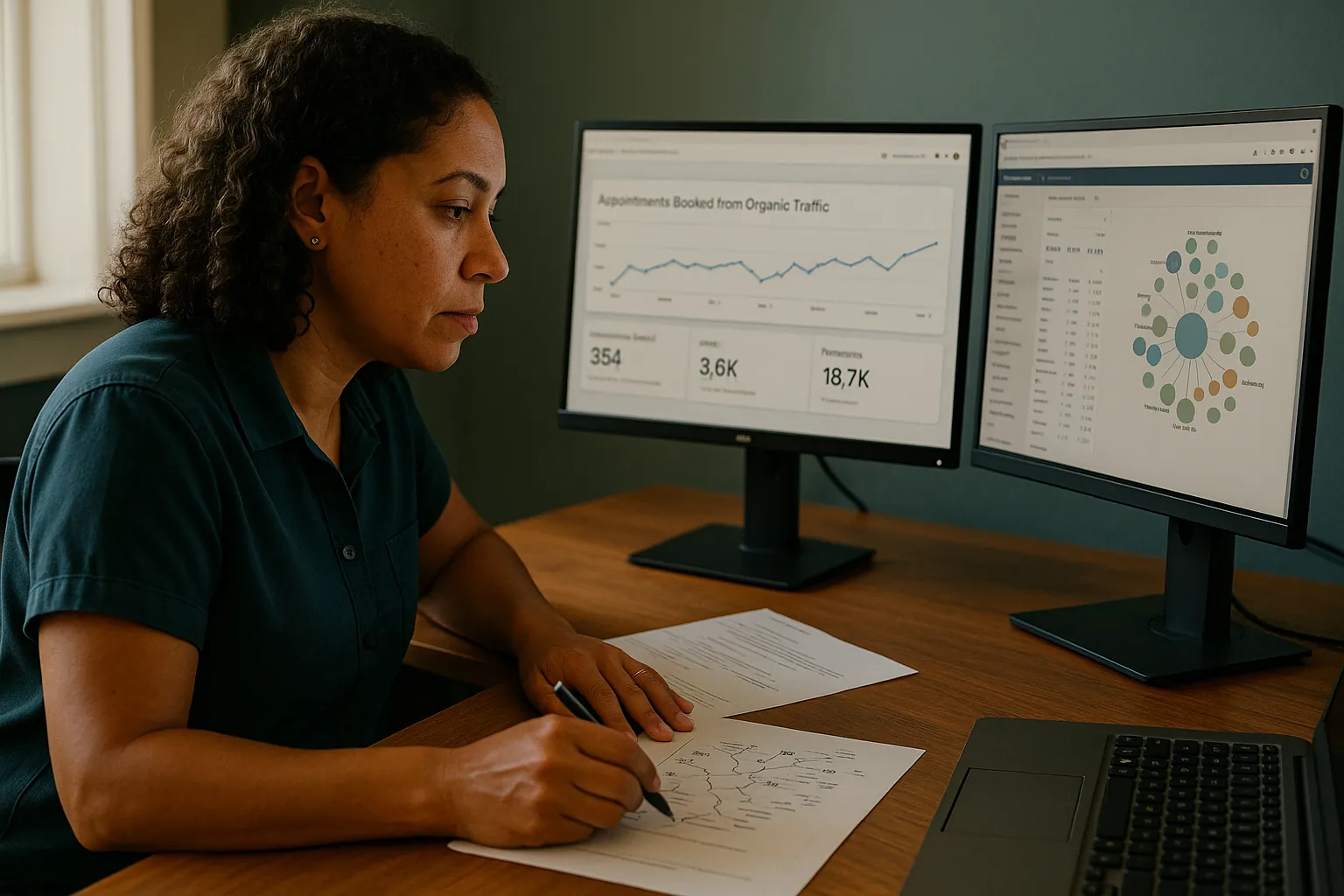
If a team reports only rankings and sessions, it is missing the commercial picture. To understand conversion impact, businesses need to look at organic traffic by landing page, query intent, device type, location, and conversion path. They also need to define conversions properly. For one company that may be purchases. For another it may be qualified form submissions, booked consultations, phone calls over a certain duration, or demo requests from target accounts.
The insights can be surprisingly practical. Sometimes SEO Services a page ranks well and gets traffic, but mobile conversions are poor because the form is too long. Sometimes blog content drives assisted conversions because people discover the brand through education, then return later through direct or branded search. Sometimes a service page underperforms because it ranks for mixed intent terms and needs clearer positioning.
This is where SEO stops being abstract and becomes operational. Good reporting should lead to page-level decisions, not just dashboard admiration.
A useful way to assess SEO impact on conversion is to watch for these patterns:
- Organic landing pages with high traffic but weak conversion, which often signals intent mismatch or poor page execution.
- Pages with moderate traffic but strong conversion, which often deserve more internal linking, content support, or link acquisition.
- Device-specific conversion gaps, especially on mobile, where technical friction tends to show up first.
- Queries that attract impressions but low click quality, where snippet messaging may need adjustment.
- Assisted conversion paths where informational content plays a meaningful role before a later commercial action.
Those patterns tell a richer story than raw ranking reports ever can.
SEO and CRO work best together
Businesses sometimes ask whether they should invest in SEO or conversion rate optimization first. In many cases, that is the wrong question.
If the site has serious UX problems, more traffic will simply expose the weakness faster. If the site converts well but lacks visibility, there is only so much growth available. The strongest gains usually come when SEO and CRO are treated as connected disciplines.
SEO brings the right people in. CRO helps them act once they arrive. The handoff is where money is made.
This does not require a massive enterprise program. Even modest changes can compound. A better search intent map leads to stronger pages. Stronger pages reduce bounce rates and improve lead quality. Faster load times increase form completion. Better internal linking helps users find relevant next steps. More persuasive proof elements raise trust. Over time, conversion rate improves not because of one dramatic trick, but because the entire search journey becomes more coherent.
I have watched companies chase conversion gains through button color tests while ignoring the fact that their organic traffic was poorly matched to the offer. I have also seen SEO teams celebrate ranking wins while sending visitors to pages that had no real chance of converting. Neither approach gets far on its own.
What businesses should expect from effective SEO Services
The phrase SEO Services covers a wide range of work, and quality varies sharply. Some providers focus narrowly on rankings. Others take a broader view and tie search strategy to revenue performance.
If conversion matters, the latter approach is what you want. That means keyword targeting built around intent, technical cleanup that improves usability, landing page recommendations grounded in buyer behavior, content strategy that addresses real objections, and reporting that tracks outcomes beyond traffic.
It also means honest trade-offs. Not every high-volume keyword is worth chasing. Not every page should target a commercial query. Not every conversion problem is an SEO problem. Sometimes the issue is offer clarity, pricing, form friction, or sales follow-up. Strong SEO professionals know where their work helps most and where another discipline needs to step in.
That realism is valuable. Search is powerful, but it is not magic. It performs best when integrated with a credible offer, a usable site, and a business that understands its audience.
Why some SEO traffic converts poorly even when rankings are strong
It is worth addressing the uncomfortable scenario many companies face: rankings improve, organic traffic rises, and conversion rate stays flat or drops.
This usually points to one of a few issues. The site may be winning broad informational queries without a clear path into the offer. The content may attract early-stage researchers rather than buyers. The pages may rank because they are relevant enough for search engines, but not persuasive enough for humans. Or the business may simply be targeting the wrong search themes.
Sometimes the decline is temporary and healthy. As a site expands content coverage, top-of-funnel traffic often grows first. Assisted conversions may rise before last-click conversions do. The mistake is assuming all organic growth should convert at the same rate. It should not.
The real question is whether the search portfolio contains enough high-intent visibility and whether the journey from discovery to action is supported properly. If not, SEO needs refinement, not abandonment.
Revenue grows when search intent, page quality, and trust line up
At its best, SEO is not a traffic trick. It is a way of making a business easier to discover, easier to understand, and easier to choose.
That is why SEO Services can improve conversion rates so meaningfully. They bring structure to audience targeting, sharpen the message on key pages, remove technical obstacles, and create a smoother path from query to decision. The result is not just more visibility. It is better-fit visitors meeting better-prepared pages.
Businesses that understand this tend to make smarter investments. They stop asking whether SEO can “drive traffic” and start asking whether it can bring in the right prospects and help them convert. That shift sounds small, but it changes the whole strategy.
And in practice, it is where the best results usually begin.
Magister Digital AI
1135 Garnet Ave #13, San Diego, CA 92109
+16193300953
FAQ About SEO Services
What do SEO services include?
SEO services can include technical site reviews, keyword and search-intent research, content improvement, internal linking, local optimization, structured data, and performance reporting. The exact scope should reflect the business, market, and goals.
How long does SEO take to show results?
Timing varies with the website's current condition, competition, and scope. Technical improvements may show movement sooner, while competitive content and authority work often require several months of consistent effort.
Do SEO services include local SEO?
They can. Local SEO commonly covers Google Business Profile optimization, accurate business citations, local schema, reviews, and service-area or location content when those elements are relevant.
How should SEO performance be measured?
Useful measures include qualified organic traffic, calls, form submissions, booked appointments, revenue influence, and visibility for searches that matter to the business. Rankings alone do not show the full outcome.